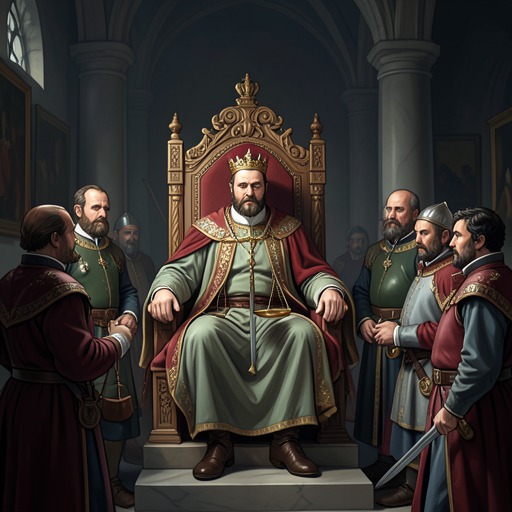
Sir Blamor de Ganis
Le Morte d'ArthurSir Blamor de Ganis is a knight of Launcelot’s family, the brother of Sir Bleoberis de Ganis, and a man whose commitment to honor shapes both his defeat by Sir Tristram and the reconciliation that follows. In the trial by combat over King Anguish, Blamor would rather die than yield; Tristram’s refusal to let that principle turn victory into death transforms an accusation of treason into a lasting alliance.
Identity and Kinship
Blamor is introduced as the brother of Sir Bleoberis de Ganis and, through him, kin to Sir Launcelot. Bleoberis describes the brothers as Launcelot’s sister’s children, a connection that matters directly when Tristram recognizes their family and decides he is reluctant to fight Bleoberis for Launcelot’s sake. The kinship also raises the stakes of Blamor’s later battle: Bleoberis urges him to remember the family’s reputation, while Tristram considers the consequences of killing a member of Launcelot’s bloodline.
The narrative presents Blamor as a recognized knight, not merely a relation of more famous men. When he is summoned to answer for the killing of Bleoberis’s cousin, the account calls him noble and of noble descent. At Arthur’s court, his reputation is also part of the reason the impending combat commands attention: Tristram has already become known for defeating Marhaus and Palamides, but Blamor’s resolve makes the judicial encounter a demanding test even for him.
The Accusation and Trial by Combat
Blamor accuses King Anguish of treason, alleging that the king treacherously killed one of Blamor’s cousins at his court in Ireland. Anguish has been summoned to Arthur’s court without knowing the reason, and the accusation leaves him facing the court’s established procedure: a person charged with treason or murder must fight the accuser or find a champion to fight in his place. In this account, murder is treated as treason, and the physical contest serves as the prescribed means of answering the charge.
The proceeding does not begin with the king deciding the truth of the accusation through testimony. Instead, Anguish must prepare a knightly answer, while the judges grant him until the third day to provide one. Tristram then agrees to champion him, saying he would rather die in the king’s cause than prove recreant. The case thus puts a formal legal custom into the hands of champions: the judgment will be enacted through combat, with honor and bodily risk attached to both the accused party and the fighters.
Combat with Sir Tristram
Before the fight, Blamor’s brother Bleoberis reminds him of their kinship to Launcelot and of the family’s record in battle. Blamor answers that he will not shame his blood: Tristram may strike him down, he says, but he will not yield or speak the word of surrender. Bleoberis warns him that Tristram is among the mightiest knights he has faced, yet Blamor accepts the contest without softening his resolve.
The two knights charge from opposite ends of the lists. Tristram unhorses Blamor, but the fall does not settle the combat. Blamor gets up, draws his sword, raises his shield, and challenges Tristram to continue on foot. Their sword fight is fierce and prolonged; the assembled kings and knights wonder that the combatants can keep standing. At last, Tristram strikes Blamor down with a blow to his helmet. Blamor has lost the field, but the question of whether he will yield—and what victory requires of Tristram—remains open.
Honor, Mercy, and Reconciliation
When he can speak, Blamor asks Tristram to kill him. He says he would rather die with honor than live in shame, and declares that Tristram cannot win the field unless he either kills him or makes him utter the word of surrender. His stance turns the combat’s customary endpoint into a moral dilemma: the victor can secure submission only by compelling a knight who refuses it, or can accept the danger and consequences of sparing him.
Tristram hesitates because he is mindful both of the cause he serves and of Blamor’s family connection to Launcelot. He goes before the judges and asks them to take the matter into their hands, arguing that it would be a pity for so noble a knight to die when shame is precisely what Blamor refuses. Anguish agrees to be guided by Tristram, whom he trusts as his champion. Bleoberis, though he acknowledges that his brother has been beaten, says that Tristram has overcome Blamor’s body but not his heart; he would accept Blamor’s death rather than have him shamed. The judges instead choose mercy, and Bleoberis accepts their decision.
The outcome is more than a reprieve. Tristram and Bleoberis raise Blamor, and the brothers are reconciled with Anguish. Blamor and Tristram exchange a pledge that neither brother will fight Tristram again, and Tristram makes the same promise to them. The account then broadens the consequence beyond the individual combat: because of this courteous battle, all of Launcelot’s kin love Tristram thereafter. A contest that begins under the rules of accusation and combat therefore ends by creating peace among the accused king, the accuser’s family, and the champion.
A Continuing Place in the Knightly Fellowship
Blamor’s later appearances show that the reconciliation does not remove him from the world of tournaments and armed contests. When Sir Launcelot gathers ten knights to search for the missing Tristram, Blamor joins the company alongside Bleoberis, Sir Bors de Ganis, Sir Ector de Maris, and other knights. Their promise is a year-long search: they will not lodge in the same place on successive nights until they find Tristram. Blamor’s participation places him among the fellowship that responds to Launcelot’s concern for Tristram, the man who once defeated him and then spared him.
At a later tournament, Blamor meets Palamides in the press of combat. Both knights are struck from their horses by their spears, and Blamor’s fall is serious enough that he requires the attention of surgeons before recovering. The episode provides a pointed contrast with the earlier duel: there, Blamor’s refusal to yield forces Tristram to seek a merciful resolution; here, the account records his vulnerability in a crowded tournament, followed by his recovery. Across these appearances, Blamor is defined less by a personal quest than by the obligations and loyalties of knightly fellowship—his brotherhood with Bleoberis, his kinship with Launcelot, and the durable friendship created with Tristram.